A German Shepherd puppy can gain five to ten pounds a month during its first year. Getting portions right during that window matters. Overfeeding a large-breed puppy can put unnecessary stress on developing joints, while underfeeding leaves them short on energy when they need it most. The chart below covers eight weeks through twelve months.
German Shepherd Puppy Feeding Chart
These ranges assume a standard large-breed puppy kibble averaging 350–400 kcal per cup. If your food is higher or lower in calorie density, adjust the cups. The calorie column is the more reliable target.
| Age | Weight Range | Cups/Day | Meals/Day | Calories/Day |
|---|---|---|---|---|
| 8 weeks | 11–17 lbs | 1–1.5 | 4 | 400–550 |
| 10 weeks | 15–21 lbs | 1.25–1.75 | 4 | 475–625 |
| 12 weeks | 18–26 lbs | 1.5–2.25 | 3 | 550–750 |
| 4 months | 28–35 lbs | 2–2.75 | 3 | 700–950 |
| 5 months | 35–44 lbs | 2.5–3.25 | 3 | 850–1,100 |
| 6 months | 42–53 lbs | 3–3.75 | 2–3 | 1,000–1,250 |
| 7 months | 48–59 lbs | 3–4 | 2 | 1,050–1,350 |
| 8 months | 53–64 lbs | 3–4 | 2 | 1,100–1,400 |
| 9 months | 56–68 lbs | 3–4 | 2 | 1,100–1,400 |
| 10 months | 58–71 lbs | 3–4 | 2 | 1,100–1,400 |
| 11 months | 60–73 lbs | 3–4 | 2 | 1,100–1,400 |
| 12 months | 60–75 lbs | 3–4 | 2 | 1,100–1,400 |
Females generally fall toward the lower end of each range. Males, especially those from working lines, often land at the upper end or slightly above.
For a broader look at portion sizes and brand-specific adjustments, see our guide on how much to feed a German Shepherd puppy.
How to Read the Chart
The numbers above are a starting point, not a prescription.
Check your food’s calorie content first. The back of the bag lists kcal per cup. A food with 450 kcal per cup means fewer cups than one with 340 to reach the same daily target. That is why the calorie column is more useful than cups alone.
Weigh your puppy regularly. Monthly weigh-ins help you catch trends. A puppy gaining weight too quickly for its frame may need portions trimmed slightly. One falling behind might need a bump. Your vet can confirm whether growth is on track during routine visits.
Adjust in small steps. If portions need changing, shift by about a quarter cup at a time and hold for a week before reassessing. Big jumps in food volume can upset a puppy’s stomach.
A food designed for large-breed puppies controls calcium and phosphorus ratios to support steady bone growth. That matters more for Shepherds than many owners realize. For help choosing one, see our best puppy food for German Shepherds roundup.
Body Condition Scoring for Puppies
No chart replaces actually looking at your puppy. The WSAVA body condition scoring system is straightforward and more accurate than any number printed on a bag.
WSAVA guidance: Body condition scoring should be used alongside weight monitoring to adjust portions. A dog at ideal condition has ribs easily felt with minimal fat covering, a visible waist from above, and an abdominal tuck from the side.
What to check:
- Ribs: You should feel individual ribs with light pressure but not see them. If you have to press hard, the puppy is carrying too much.
- Waist from above: Looking down, there should be a visible tuck behind the ribs. A straight or bulging outline suggests overfeeding.
- Belly from the side: The abdomen should slope upward from the ribcage to the hind legs. A rounded or hanging belly is a red flag.
Shepherd puppies should look lean. A slightly bony appearance between four and eight months is normal for the breed. They are growing into their frame. A puppy whose ribs and spine are prominently visible, though, needs more food.
Adjusting Portions
Treat the chart as your baseline, then fine-tune based on what your puppy’s body tells you.
Cut back by a quarter cup if stools are consistently loose, the belly doesn’t tuck up, or weight is gaining faster than the ranges above. Overfeeding a Shepherd puppy carries real consequences. Growing too fast puts extra load on joints, and the breed is already among those commonly associated with hip and elbow problems.
Add a quarter cup if ribs, spine, and hip bones are clearly visible, the puppy has low energy or a dull coat, or weight is falling below expected ranges consistently. An underfed puppy won’t have the building blocks for proper development.
If adjustments in either direction don’t resolve the issue within a couple of weeks, check with your vet. Parasites, absorption problems, or other medical factors could be involved.
Signs of Overfeeding and Underfeeding
Overfeeding signs: loose or frequent stools, a rounded belly that doesn’t tuck, difficulty feeling ribs with gentle pressure, lethargy after meals.
Underfeeding signs: ribs and hip bones clearly visible, low energy or reluctance to play, dull and dry coat, eating too fast or scavenging constantly.
For more on feeding practices during growth, the transition from puppy to adult food typically happens between 12 and 18 months. We cover the full process, including signs your puppy is ready, in our article on when to switch from puppy to adult food.
Frequently Asked Questions
How many times a day should I feed my German Shepherd puppy? Four meals a day from 8 to 12 weeks. Drop to three around 12 weeks, then two by six to seven months. Two meals per day works well for the rest of their life. It helps reduce the risk of bloat, which Shepherds can be prone to.
Should I free-feed my Shepherd puppy? No. Leaving food out all day makes it impossible to track how much your puppy actually eats. Measured meals at set times give you better control and make housetraining easier too.
My puppy seems hungry after meals. Should I feed more? Not necessarily. Shepherd puppies will almost always act hungry. Go by body condition, not behaviour. If ribs are easy to feel and weight is tracking within range, portions are likely fine. If the puppy genuinely looks thin, add a quarter cup.
Do male and female puppies need different amounts? Males are typically larger and need more food, especially from four months onward. A male at six months might eat 3.5 cups where a female of the same age eats 3. Use the weight ranges in the chart as your guide rather than going strictly by sex.
Individual needs vary. This chart provides general starting points. Your vet can help dial in the right amount for your specific puppy.
Explore more feeding guides on our German Shepherd food hub.
Disclaimer: This content is for general informational purposes only and is not veterinary advice. Consult a licensed veterinarian for decisions about your dog's health, diet, or medical care. Read full disclaimer →
Related Articles

Best Puppy Food for German Shepherds
Top 5 puppy foods for German Shepherds. Large-breed formulas with controlled calcium, joint support, and digestible proteins for German Shepherd puppies.
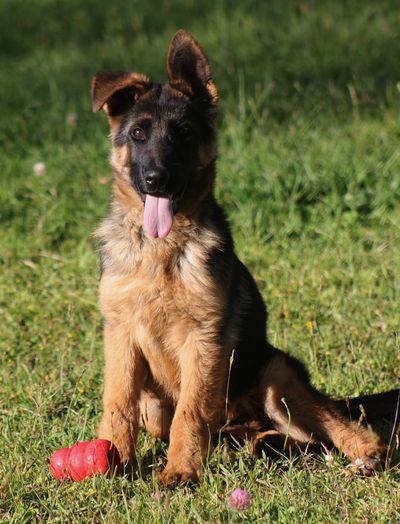
How Much to Feed a German Shepherd Puppy
Feeding amounts for German Shepherd puppies by age, from 8 weeks to 12 months. Cups per day, meal frequency, and when to adjust.

When to Switch German Shepherd from Puppy to Adult Food
When and how to transition your German Shepherd from puppy food to adult food. Brand recommendations, timing, and a day-by-day transition plan.